

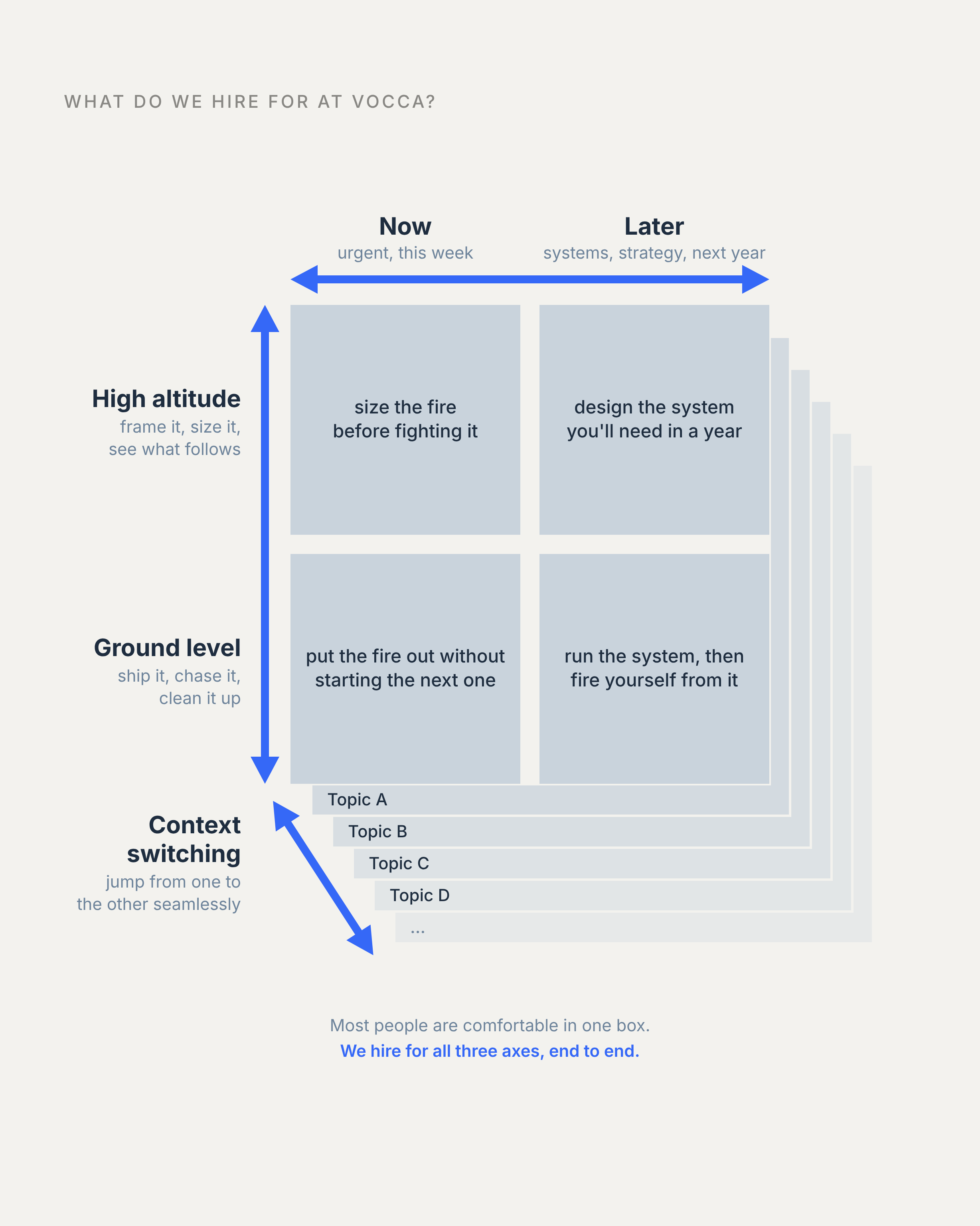
For the past few weeks I've been interviewing a lot, and I open every conversation with roughly the same ask: walk me through a project where you had to go very high and very low, and through a time where topics you handled had nothing to do with one another. In doing so, I'm checking three dimensions.
The vertical one is altitude: how easily you go from framing a problem to doing the work yourself. The horizontal one is time horizon: how you handle what's urgent this week without mortgaging next year. The third is context switching: how many unrelated topics you can carry in a day, and how cleanly you jump from one to the other.
I started with Founder Associates because their job description more or less is the three axes. But I think it holds for every role in an early-stage company, and that's what we hire for at Vocca.
The vertical one: altitude
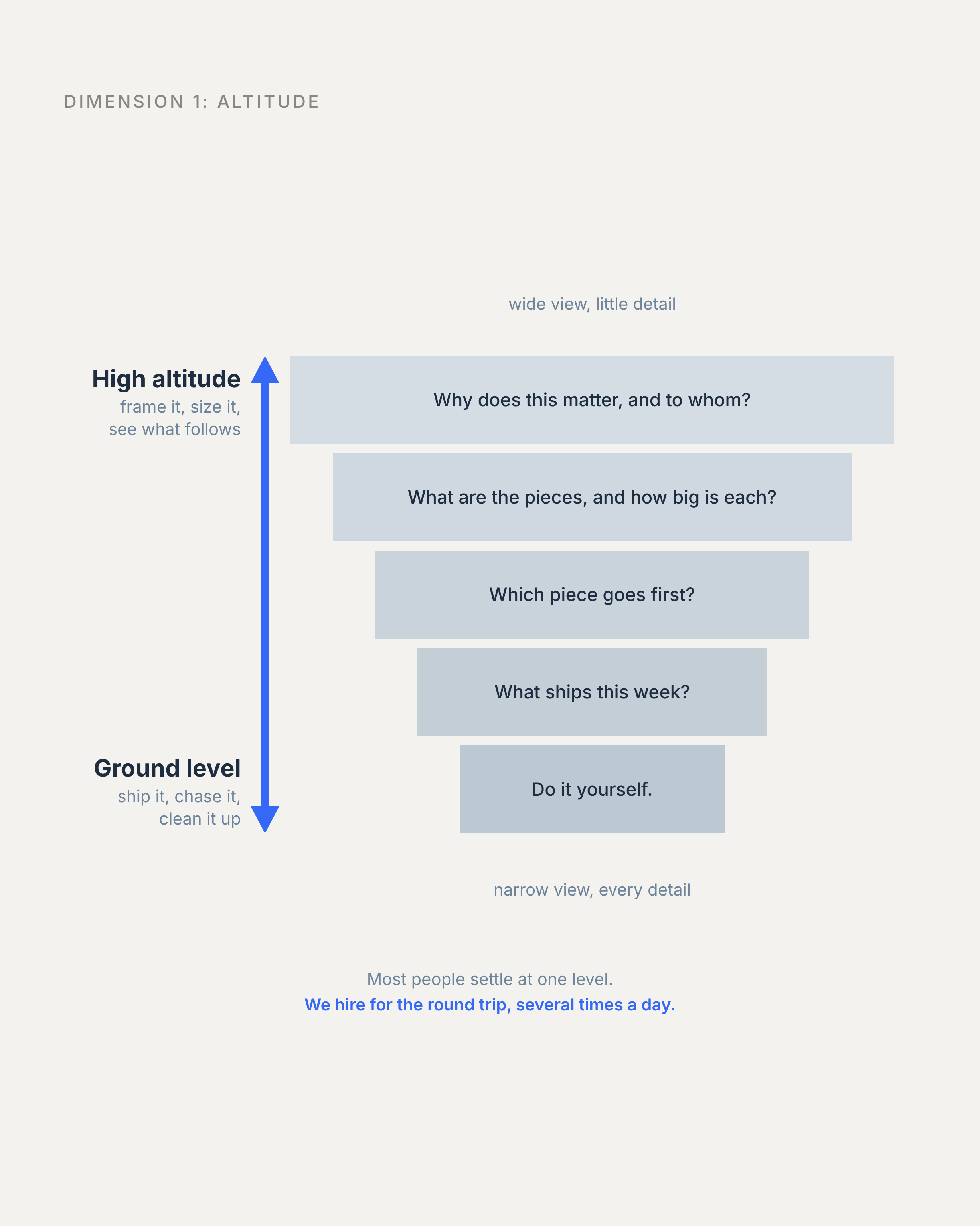
At the top, you're at 30,000 feet. You frame the problem, break it into smaller pieces, size each of them, see the second-order effects and decide which piece goes first. At the bottom, you're an individual contributor again: you spotted the gap, there's nobody to close it, so you close it yourself. That includes the unglamorous part of the job.
Plenty of people are excellent at one of the two. Those who only fly high produce clean frameworks that nobody executes, and tend to find out on contact that the framework was wrong. Those who only stay low are busy all day, often on the wrong problem. Neither is a character flaw, it's usually what the previous environment rewarded: a large company has enough layers for strategy and execution to be two different jobs. An early-stage company doesn't have that luxury, the resources simply aren't there.
What we look for is the shuttle between the two, several times a day, in both directions. On the way down, it starts with a few minutes of overview before diving in, to calibrate how granular the answer needs to be before allocating a single hour. On the way up, it's the reflex of asking what the grind just taught you. Sitting in the problem is what gives you an actual edge when you solve it.
The horizontal one: time horizon
Any given week throws urgent topics and long-term ones at you. The lazy read is that you handle the former now and the latter once things calm down (they don't). What we look for is people who don't treat them as two piles, and who work on both at once.
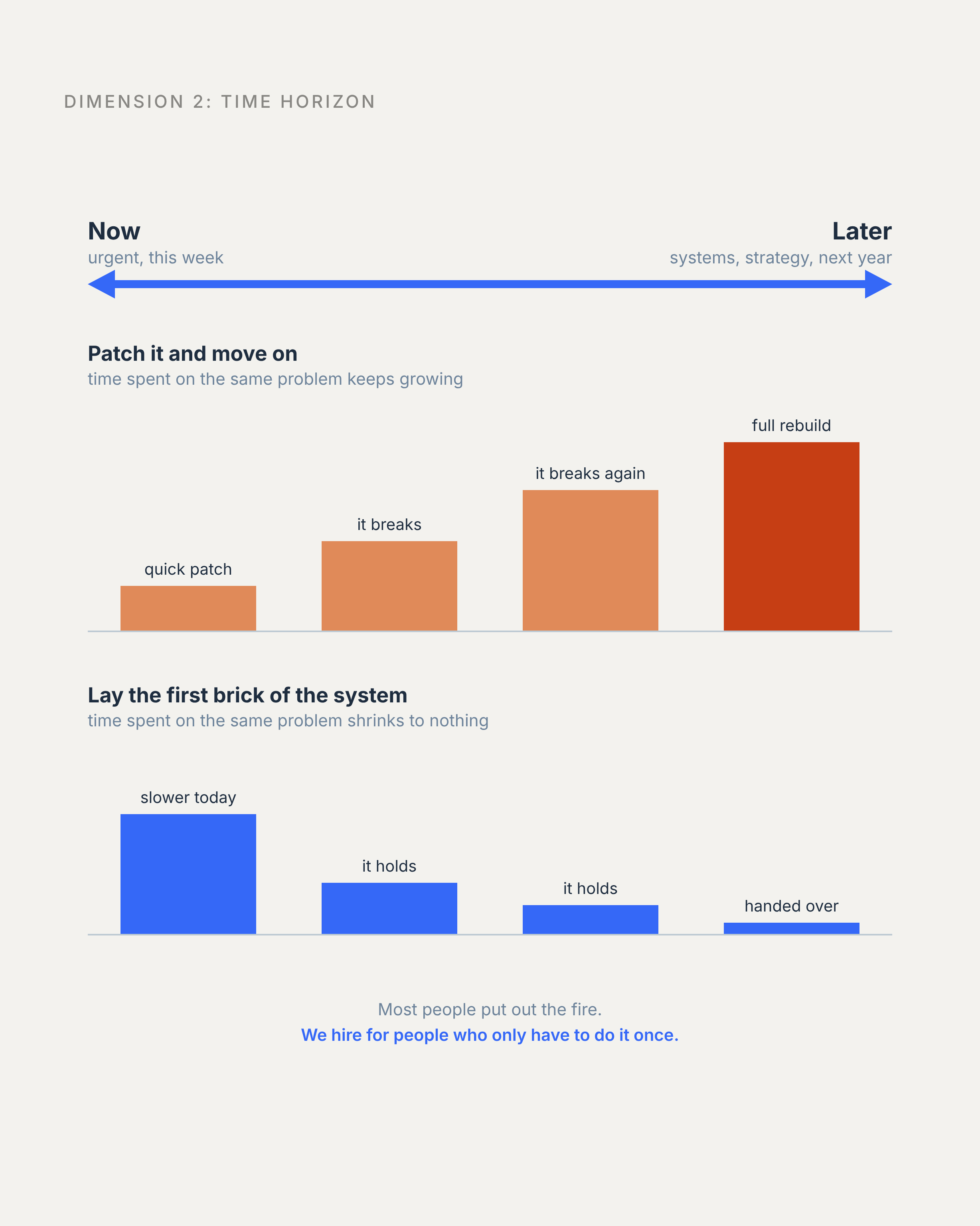
It shows in how they put out a fire. They put it out, because it's burning, but they already know what the patch will break two quarters from now and shape the first step so it doesn't. Their fix takes a bit longer today and then stops costing anything. The quick patch comes back, a little bigger each time, until someone rebuilds the whole thing anyway.
It also shows in how they push a deadline back. Not because they can afford to wait, but because they've mapped what's coming and would rather lay the right base than a non-scalable one they'll tear down later.
A caveat, because the opposite trap is just as real. Thinking long term is not building for the scale you'll have in two years, or solving a pain that isn't acute yet. It's choosing a first step small enough to ship on Monday and solid enough for the next ten to stack on it. And once the system runs, the last move is to fire yourself from it: document it, hand it over, go find the next fire.
The third one: context switching
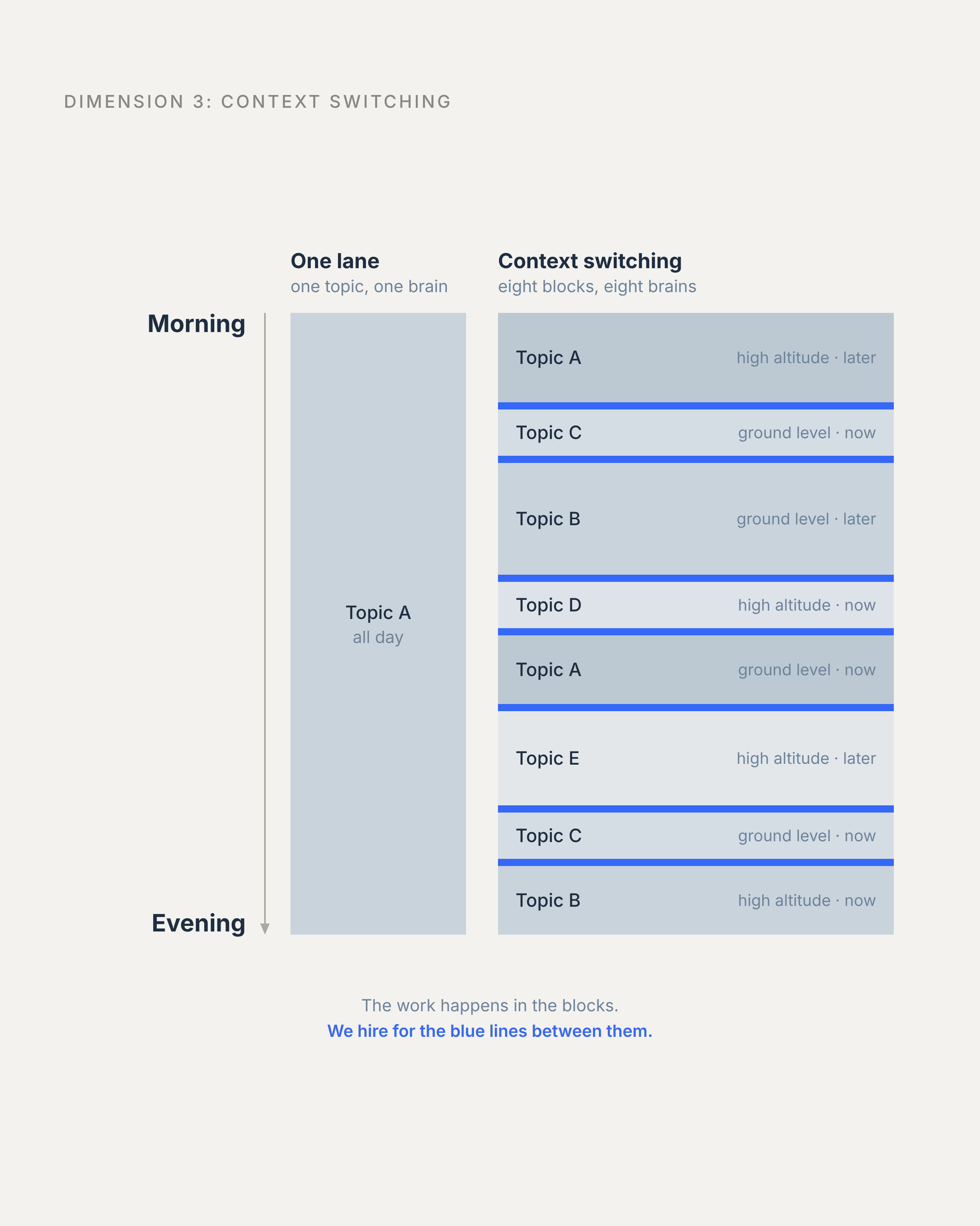
The third dimension is the range of topics you're likely to work on, and how fast you move between them. Topic A in the morning, topic B before lunch, then C, back to A, and D lands out of nowhere at 5pm because the company moves fast and nobody saw it coming. None of them sit at the same altitude or on the same clock, so you don't use the same brain at the same time of day. Sometimes you change brains three times in five minutes, and I'm barely exaggerating.
It's obvious for transversal roles, but I think it now holds whatever the job and whatever the scope. We expect more from a single individual than we used to, the tooling makes it possible, and no early-stage startup on earth is sufficiently staffed to think otherwise. "That's not my job" isn't a sentence that survives very long in that kind of environment.
Two things make it work. The first is learning speed: you don't need to be the expert on the topic, you need to become one faster than the experts did. The second is the switch itself. Every topic comes with its own people, its own vocabulary and its own level of seniority in the room, and the cost of jumping badly is that you bring the last conversation's brain into the next one. The people who are good at this jump from one to the other seamlessly, and leave each topic in a state where someone else (or themselves, a few hours later) can pick it up and hit the ground running.
All three at once
Put the three together and you get the actual day: topics that have nothing to do with one another, none of them at the same altitude or on the same clock. Staying high is comfortable, staying in the weeds is comfortable, staying in your lane is comfortable, and firefighting is oddly comfortable too, since the urgency does the prioritizing for you.
On the other hand, covering the whole map means being slightly out of your depth somewhere every single day, and finding that fun. If that sounds like your idea of a good week, you know where to find us!