

In most medical centers, the primary source of administrative burnout has become impossible to ignore: the phone never stops ringing.
More than 70% of appointments are still booked by phone, and each day is shaped by a continuous stream of calls, urgent requests, exam confirmations, and administrative tasks that are impossible to prioritize.
This overload is not inevitable. New AI medical receptionist systems now make it possible to regain control, and this is exactly what we observe in centers equipped with Vocca.
Below, we walk through a full day in a medical center, hour by hour, to show what operations look like before and after deploying an AI-powered call-handling system.
Summary: The Day Before / After at a Glance
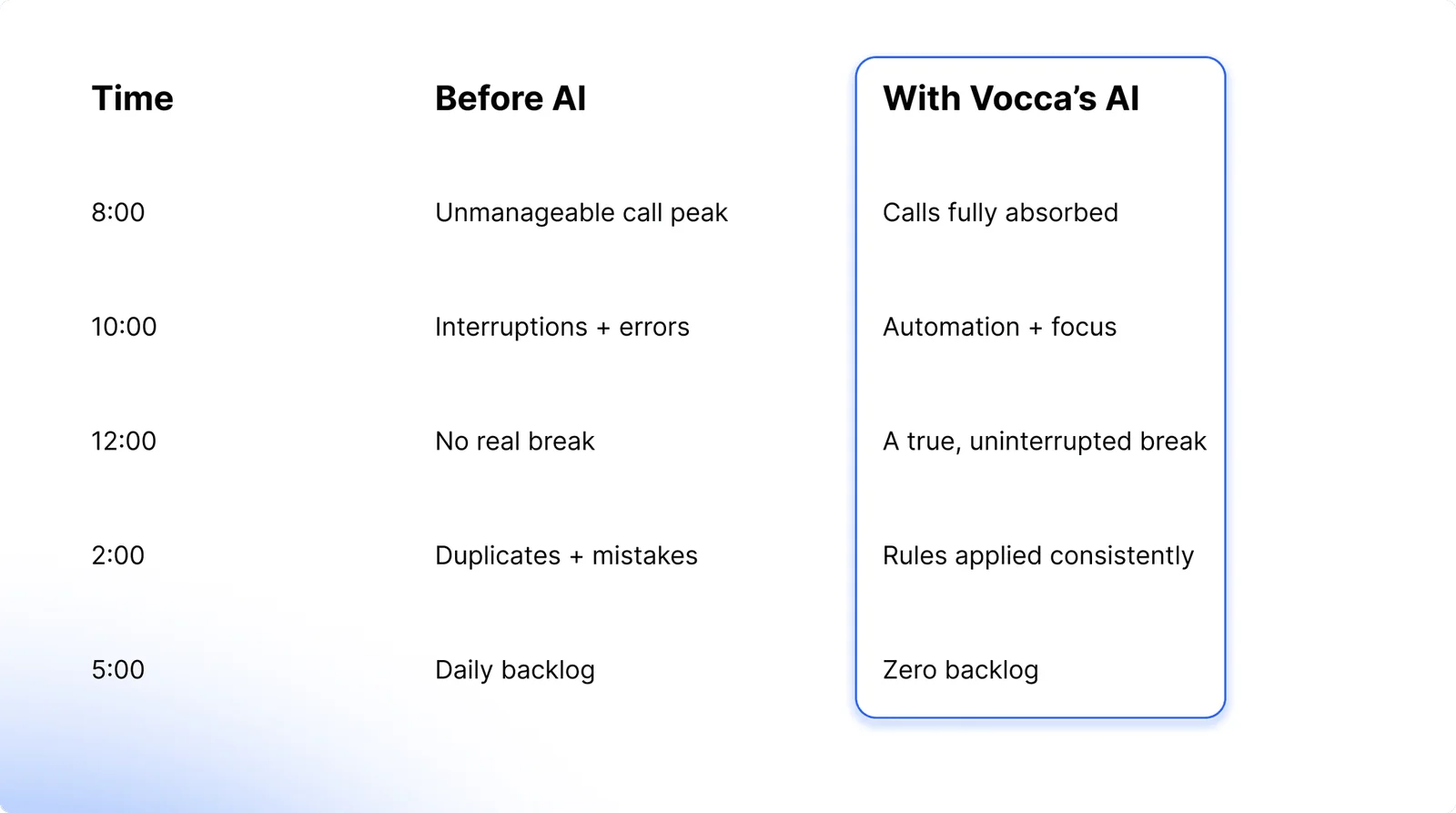
8:00 AM - Opening the Center: The Morning Call Surge
Before: A High-Pressure Start to the Day
At 8:00 AM, several phone lines are already ringing.
Patients are arriving at the front desk, often stressed or running late. A receptionist tries to manage the flow but must interrupt every interaction to answer calls. The incoming requests are varied: rescheduling, checking instructions, confirming an exam, adding an attendee, asking the doctor a question…
Consequences:
- long waiting times
- immediate stress
- frequent booking errors
- planning disruptions from the first hour
In many facilities, 40–60% of morning calls go unanswered, creating a backlog that will slow the rest of the day.
After: A Calm, Controlled Start Thanks to the AI Medical Receptionist
With an AI medical receptionist:
- all incoming calls are handled instantly
- appointments are created, modified, or cancelled according to internal rules
- front-desk patients receive proper attention
- the schedule stays clean, with consistent filtering and rule application
The day starts smoothly. Receptionists can actually welcome patients instead of being pulled in three directions by 8:03 AM.
10:00 AM - Mid-Morning: Urgencies, Reminders, Modifications
Before: Cognitive Overload Sets In
By mid-morning, receptionists are juggling:
- manual reminder calls to prevent no-shows
- urgent patient requests
- people waiting at the counter
- doctor-specific constraints
- the constant interruption of ringing phones
Forced multitasking increases error rates by 20–40%. Focus is lost, and the mental load climbs.
After: A Structured, Fluid Workflow
With an AI medical receptionist or automated remote medical secretary:
- reminders and confirmations are fully automated
- no-show rates decrease
- interruptions drop drastically
- staff availability increases
- attention shifts to complex cases
The difference is immediately noticeable: the morning is finally under control.
12:00 PM - Lunchtime… In Theory
Before: A Break That Isn’t a Break
The phone keeps ringing through lunch.
Receptionists often eat quickly near their workstation, picking up calls between bites. Fatigue and frustration accumulate.
After: The Break Is Truly a Break
The AI medical receptionist continues handling calls at 100%.
- no missed calls
- no backlog to catch up afterward
- a real moment of rest for the team
A simple shift, but one that changes everything!
2:00 PM - Afternoon: Modifications, Rescheduling, Patient Information
Before: An Afternoon Driven by Unpredictability
The afternoon often brings:
- a chain of appointment modifications
- duplicate calls from patients who didn’t reach the center earlier
- complex instructions depending on the exam
- errors that frustrate practitioners and disrupt schedules
Internal coordination becomes harder as the day progresses.
After: Accuracy and Stability
With an AI medical receptionist:
- internal rules are applied consistently
- no new patients for certain physicians
- age restrictions enforced
- specific slot durations respected
- allowed visit reasons filtered properly
- duplicate calls disappear
- schedules remain clean
- doctors are better prepared and less interrupted
The afternoon becomes controlled and predictable, not a sequence of emergencies.
5:00 PM — Closing Time… But Not the End of the Calls
Before: The Final Rush
Phones are still ringing.
Receptionists try to take last-minute calls, leave messages, and prepare files for the next day. The shift rarely ends on time.
Missed evening calls become tomorrow’s morning backlog.
After: A Clean End to the Day
The AI medical receptionist remains active 24/7.
- calls are handled after closing
- no backlog accumulates
- receptionists finish their day on time
- energy and morale improve sustainably
Conclusion - A Structural Shift for Medical Centers
The daily pressure on reception teams isn’t a personal issue, it’s a structural result of call volume, complex rules, and patient expectations.
The AI medical receptionist fundamentally improves the day:
- fewer calls handled manually
- fewer errors
- less stress
- a more organized center
- a better experience for patients and staff
This is what we observe every day in medical centers equipped with Vocca.
More articles to explore.